Center for Professional Development
ACHENA is committed to partnering with course providers and homeopathic societies to present a wide selection of courses to meet the needs of practitioners, students and others studying Classical Homeopathy.
ACHENA Approved Course Listing

Use interactive table features to find courses
If you are looking for CEUs, the Approved Course Listing is your resource for all courses approved by ACHENA, offered by homeopathic professionals and providing content that meets ACHENA standards. Courses can be attended at live events, taken online at your convenience, or purchased as recordings you can refer to again and again. Using the interactive features of the table, you can search by keywords, name of provider or speaker, number of CEU credits, etc.
Approved courses fall into three “levels” depending on subject and depth of content:
- Level 1 courses aim to help practitioners address gaps in practice, fine tune skills and master advanced topics, beyond the fundamental standards outlined in the ACHENA Eligibility and Accreditation Manual (see: Standard 8 for the Professional Homeopathic Practitioner Program of Study).
- Level 2 courses aim to build personal capacity for successful practice including topics that address ethical practice and management, communication skills and/or exposure to new ideas in the field.
- Level 3 courses aim to reinforce and integrate learning included in the Professional Homeopathic Practitioner Program.
ACHENA CPD Program
Continuing Professional Development is a foundational element of homeopathic education and practice. A lifetime commitment to the study of the art and science of Homeopathy advances the collective responsibility of the profession, as well as enhances consumer protection.
It is the responsibility of each professional to know the statutory and regulatory requirements to maintain board certification or licensure in their state / province and to fulfill those CPD requirements. At minimum, professional homeopaths must meet CPD requirements of the examination boards that grant them certification and of the professional associations to which they may belong.
Definition
ACHENA’s CPD Program reviews and approves advanced education and training courses for professional practitioners, beyond their fundamental postsecondary homeopathic training. ACHENA also supports but does not grant approval of other continuing education requirements, including publication in professional journals, teaching and volunteer service hours.
Contact an organization that renews and grants certification or licensure for their specific CPD policy and the annual CPD hours they require.
Purpose
ACHENA Approved CPD Courses aim to meet the widely accepted needs and challenges of professional homeopaths in practice by increasing the understanding and application of Classical Homeopathy, as stated in the Standards for Homeopathic Education and Competencies. Competency-based education and training is expected across interdisciplinary, educational and healthcare contexts, including Homeopathy.
Every professional homeopath that participates in an ACHENA Approved CPD Course publicly commits to independent evaluation and verification of their continuing education. By maintaining a record of CPD activities in the form of a portfolio, the professional maximizes the benefits of the learning gained.
ACHENA approves courses of three types
Those that
- Address gaps in practice, fine tune skills and provide professional training on advanced topics. (See Standard 8: Professional Homeopathic Practitioner Program of Study).
- Enhance practice management skills, strengthen communication skills and provide exposure to new ideas in the field.
- Reinforce, integrate and advance topics adjunct to classical Homeopathy topics.

ACHENA CPD Application Steps
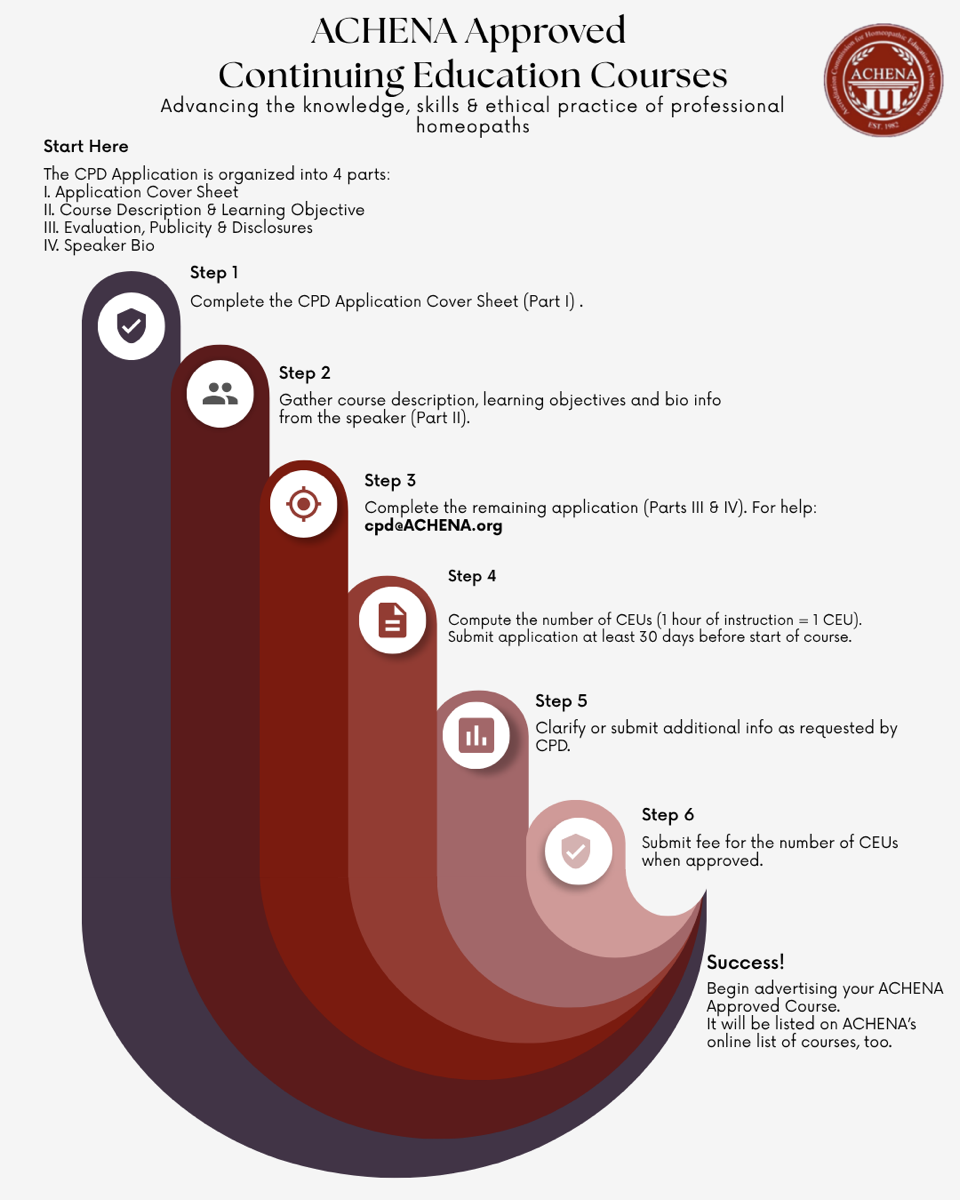
CPD Course Approval – Application overview
I. COVER SHEET
Basic info about the course, speaker and contact info for your organization
II. COURSE DESCRIPTION & LEARNING OBJECTIVES
Course Description
Essential elements of what will be learned from the course, including who the course is for and how it will be taught
• Essential Elements of a Course Description
• Sample Course Description
Learning Objectives
3 to 6 statements describing measurable skills attendees will learn from the course
• How to Write Learning Objectives
• Action Verbs for Writing Learning Objectives – list
• Sample list of learning objectives
III. EVALUATION, PUBLICITY, VERIFICATION of PARTICIPATION & DISCLOSURES
Evaluation
Sample evaluation tool
Publicity
• Advertising copy, brochure or poster incorporating your course description
• Link to your course registration page
Financial Disclosure & Commercial support
IV. SPEAKER BIO
Includes degrees, years, accrediting institutions; credentials; experience; presentations; publications, etc. for each speaker.
CPD Application:
Only 4 pages
Fill-in online
Save & continue
CPD Course Approval – Application Fees
| Regular course | up to 19 CEUs | $25/course hour; 2-year expiration |
| Bulk course #1 | 20 to 49 CEUs | $20/course hour; 2-year expiration |
| Bulk course #2 | 50 to 199 CEUs | $15/course hour; 2-year expiration |
| Bulk course #3 | 200 or more CEUs | $10/course hour; 2-year expiration |
| Renewals | 50% of original fee at application; 2-year expiration | |
| State / Regional Homeopathic Societies | $20/course hour; 3-year expiration | |
Fees will be invoiced by ACHENA at the time of course approval by CPD. After confirmation of fee payment has been received, the course can be advertised as ACHENA approved.
Course fees cover Continuing Education Units (CEUs) to an unlimited number of students, for an unlimited number of deliveries of the same course from the date of the course start to its stated expiration date.
Essential Elements of a Course Description
The course is your “product” and potential attendees need solid information in order to decide whether to register or not!
The course description is a concise summary of the course, briefly stating its essentials. In three to five sentences, it needs to include:
- Who is the intended audience for the course?
- What will be covered in the course? (specific content, skills, outcomes)
- How the course will be taught? (case studies, videos, slides, etc.)
- How many hours and CEUs?
A succinct
Course Description
is key!
Sample Course Description
This 3-hour / 3-CEU course for both practitioners and home users, describes the use of acute Homeopathy in the treatment of menstrual cramping. Using lecture and slides, there is a short review of the physiology and pathophysiology of menstrual cramping. We discuss cases that will teach you to differentiate the need for constitutional vs acute intervention. You will learn to recognize the classic symptom presentations of acute menstrual cramping and find a matching remedy that mirrors these symptoms in the materia medica.
The course description and the learning objectives are the specifics a potential attendee needs to know when deciding whether or not to register. Be sure the course description and the learning objectives work together. Check them against each other throughout the writing process, whether you begin by listing your objectives first and using them to write your course description, OR you write the course description first and develop your objectives from there.
The course description is not the same as publicity. Your promotional pitch will include the brief course description and the learning objectives, as well as the speaker bio, registration instructions, date(s) of the course, and a few sentences to create interest in the topic and/or your event.
Use keywords in your course description so that potential registrants can find the course in a computer search.
A succinct course description should be about 50 – 100 words.
How to Write Learning Objectives
Learning objectives describe measurable skills a participant will acquire after completing a course.
Use AWBAT as your guide – Attendees Will Be Able To…
• List 3 to 6 statements relating to specific course content
• The number of objectives is based on the length of the course
A learning objective begins with a strong, measurable, action verb, for example, describe or demonstrate, rather than understand or realize. See Learning Objective Action Verbs
Sample Learning Objectives
- Explain the physiology and pathophysiology of menstrual cramping
- Identify menstrual cramping that indicates the need for acute homeopathic intervention
- Demonstrate the ability to match the symptom presentations of acute menstrual cramping with homeopathic remedies that have corresponding symptoms in the materia medica.
The course description and the learning objectives are the specifics a potential attendee needs to know when deciding whether or not to register. Be sure the course description and the learning objectives work together. Check them against each other throughout the writing process, whether you begin by listing your objectives first and using them to write your course description, OR you write the course description first and develop your objectives from there.
Finally, use the course objectives to develop the course evaluation tool.
Action Verbs for Writing Learning Objectives
Learning objectives describe measurable skills a participant will acquire after completing a course.
- Each objective begins with an action verb
It completes this sentence “After this course, the participant will be able to…” - Objectives must be observable and measurable
(Do not use “learn,” know” or “understand”)
Examples of ACTION VERBS based on Bloom’s Taxonomy
| KNOWLEDGE | COMPREHENSION | APPLICATION | ANALYSIS | SYNTHESIS | EVALUATION |
| Cite | Compute | Apply | Analyze | Arrange | Assess |
| Count | Describe | Demonstrate | Appraise | Assemble | Choose |
| Define | Discuss | Dramatize | Calculate | Collect | Compare |
| Draw | Explain | Employ | Categorize | Compose | Criticize |
| List | Express | Illustrate | Contract | Construct | Create |
| Name | Identify | Interpret | Debate | Record | Evaluate |
| Relate | Estimate | Operate | Diagram | Formulate | Judge |
| Repeat | Locate | Practice | Differentiate | Integrate | Measure |
| Underline | Report | Inventory | Examine | Manage | Rank |
| Tell | Restate | Question | Organize | Rate | |
| Translate | Review | Prescribe | Plan | Revise | |
| Use | Schedule | Select | Score | ||
| Sketch | |||||
| Propose |

Approved Provider Program
High-volume course providers may apply for ACHENA Approved Provider status. This is an advantage for organizations with a course portfolio that includes more than 250 hours of continuing education training. It saves money and eliminates the need for individual CPD course applications. ACHENA Approved Provider status also attests to the quality of the training that the organization offers to the homeopathic community.
Organizational CPD providers are required to verify that they meet ACHENA standards as a training vendor. They do this by applying to ACHENA for each CPD course approval. By contrast, an ACHENA Approved Provider (AP) curates their own course materials, monitors attendance, conducts evaluations and issues CEU certificates.
Through the AP application process, the organization shows how they meet the standards and how they will implement the requirements. When the application is approved, the AP is issued a unique insignia to use on their course requirement information, promotional materials and course completion certificates.
Approved Providers complete an Annual Report, notifying ACHENA of new, modified or retired courses. After review of each AP Annual Report, an updated AP number will be issued. Renewal may be applied for when the 6-year approval term ends.
An Approved Provider’s catalog of their approved CPD courses is included on the ACHENA website list of accredited CPD training.
All ACHENA Accredited Schools have Approved Provider status included.
Contact admin@achena.org for all inquiries about the Approved Provider Program.
Approved Provider Fees
Application fee $500.
Annual fee may be paid quarterly.
| Tier 1 | 750+ CEUs | $4,000 annually ($4/course hour) |
| Tier 2 | 500 to 749 CEUs | $3,357 annually ($4.50/course hour) |
| Tier 3 | 250 to 499 CEUs | $2,500 annually ($5/course hour) |
Approved Provider Insignia
The Approved Provider insignia and accompanying statement shall be used by the AP for their promotional materials and on the CEU certificates they issue.
[AP Name] is an Approved Provider of Homeopathic Continuing Professional Development, recognized with distinction by the Accreditation Commission for Homeopathic Education in North America (ACHENA).
Approved Provider CEU Certificate Sample
Continuing Professional Education Certificate
_________________________________________________________________
Student Name & ID Number (e.g. last 4 digits of Driver’s license, or other identifying #)
ACHENA approves and designates a total of_____ (hours of course) CEUs for
(Title of Course)
________________________________
(Name of Presenter)
________________________________
Attendance Location or Distance Learning Location, if applicable
Address _____________________
City, State, Zip ____________________________
Date(s) attended _________________________________________
Approved Provider name and number____________________________________
Address____________________________________________
City, State Zip_______________________________________
Email address (main)___________________________________________
This Continuing Professional Education Course was approved by the Accreditation Commission for Homeopathic Education in North America (ACHENA)
To receive continuing education units (CEUs):
• Register and fully attend all presentations
• Complete your evaluation online
• Retrieve and save your certificate electronically
Disclaimer: While ACHENA supports academic freedom and healthy debate within the wider homeopathic community, ACHENA educational standards and policies focus upon the core principles and best practices of Classical Homeopathy.